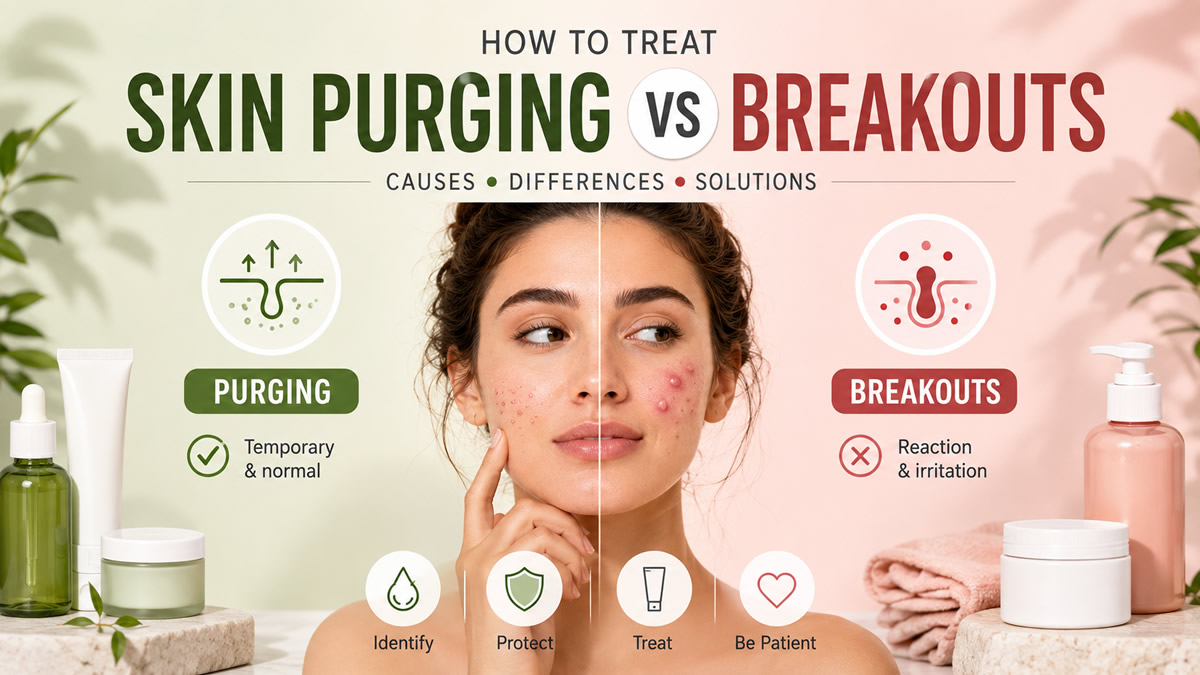
How to Treat Skin Purging vs Breakouts: Causes, Differences and Solutions
Written by Grace Reyes — Independent skincare researcher who reads ingredient labels obsessively so you don’t have to.
Starting a new skincare product often leads to a dilemma: skin purging vs breakouts and knowing which one you are experiencing is essential for maintaining a healthy skin barrier. Differentiating between the two prevents you from treating a purge like a bad reaction, which might make you quit an effective product too early.
On the flip side, mistaking a breakout for purging can cause severe inflammation and scarring. Purging occurs when active ingredients speed up cell turnover, while breakouts stem from clogged pores or reactions. Knowing the triggers and symptoms helps you adjust your routine safely and protect your skin barrier.
What Is Skin Purging?
Skin purging is a temporary skin reaction that occurs when you introduce a product that accelerates your skin’s natural cell turnover rate. Under normal circumstances, your skin takes about 28 days to shed dead skin cells and bring fresh new cells to the surface. However, certain active skincare ingredients speed up this cycle significantly.
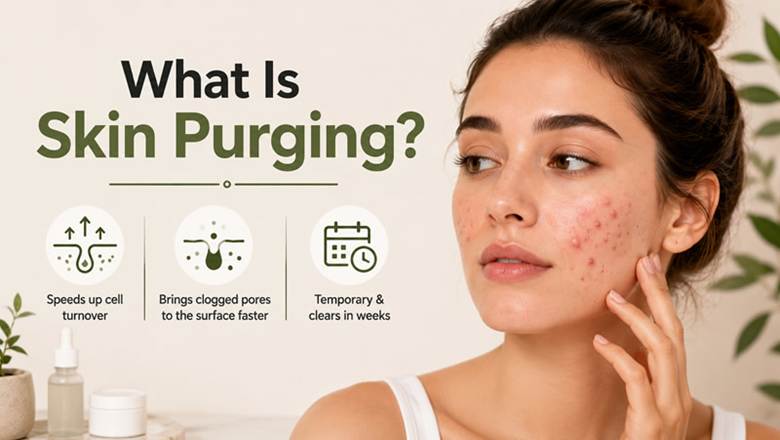
When cell turnover accelerates, microcomedones (tiny, invisible clogs formed deep within your pores from dead cells and excess sebum) are forced to the surface much faster than usual. In simple terms, purging does not create new clogged pores; it simply fast-forwards the lifespan of blemishes that were already forming under your skin. Before treating any reaction, make sure you identify your real skin type to choose suitable active ingredients.
Common Skincare Ingredients That Cause Purging
If your new product does not contain chemical exfoliants or cell turnover accelerators, your skin is not purging. True purging is almost exclusively triggered by specific active ingredients:
- Retinoids & Derivatives: Tretinoin, Retinol, Adapalene, Retinyl Palmitate, and Tazorotene.
- Alpha Hydroxy Acids (AHAs): Glycolic Acid, Lactic Acid, and Mandelic Acid.
- Beta Hydroxy Acids (BHAs): Salicylic Acid.
- Polyhydroxy Acids (PHAs): Gluconolactone and Lactobionic Acid.
- Vitamin C Derivatives: L-Ascorbic Acid (particularly in high, acidic concentrations).
- Other Actives: Benzoyl Peroxide, Azelaic Acid, and professional-grade chemical peels.
What Is a Regular Breakout?
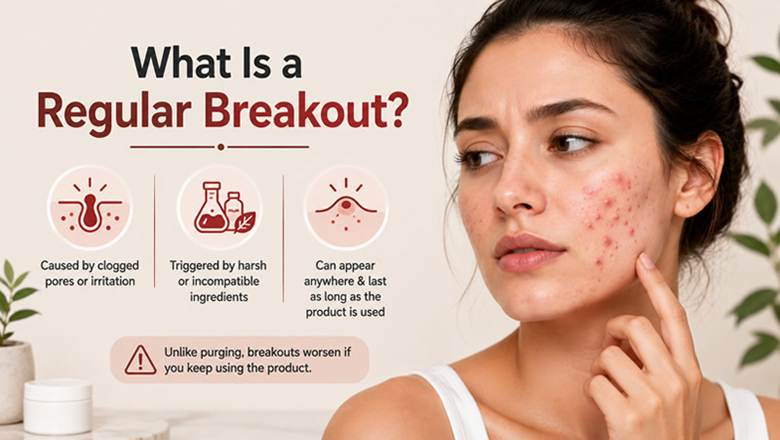
A regular breakout occurs when a product clogs your pores, irritates your skin barrier, or triggers an allergic response. Unlike purging, a breakout happens because your skin is reacting negatively to one or more ingredients in a formula.
Products that cause regular breakouts usually contain pore-clogging (comedogenic) oils, heavy silicones, artificial fragrances, harsh drying alcohols, or synthetic waxes. Breakouts can happen with any skincare product, including simple hydrating cleansers, rich moisturisers, physical sunscreens, or makeup items.
Skin Purging vs Breakouts: 4 Key Differences
To figure out what is happening on your face right now, compare your symptoms using these four key indicators:
| Feature | Skin Purging | Regular Breakouts |
| Active Ingredients | Caused only by active exfoliants or retinoids. | Caused by non-exfoliating products (creams, sunscreens, oils). |
| Blemish Location | Appears in areas where you normally get congestion. | Appears in brand-new zones where you rarely get pimples. |
| Type of Blemishes | Small whiteheads, blackheads, and tiny red bumps. | Deep, painful cysts, itchy papules, or inflamed pustules. |
| Duration & Timeline | Clears up within 4 to 6 weeks (one skin cycle). | Persists or worsens as long as you keep using the product. |
1. The Location Test
Look closely at where the bumps are appearing. If you routinely get clogged pores on your chin and nose, and the new retinoid makes bumps pop up in those exact zones, it is likely purging. However, if your skin is normally clear on your cheeks and you suddenly develop deep pimples there after using a new moisturiser, it is a regular breakout.
2. The Timeline Factor
Purging has a definite shelf life. Because it speeds up a natural cycle, a purge typically peaks around 2 to 3 weeks in and fully resolves within 4 to 6 weeks. Regular breakouts will not stop until you stop applying the offensive product.
How to Treat Skin Purging (Step-by-Step)
If you have confirmed that your skin is purging from an active ingredient, the key is management, protection, and patience. If your barrier feels inflamed, simplify your routine and use gentle, alcohol-free toners to calm redness.
1. Do Not Stop, But Slow Down
You do not need to discard the product completely. If the purge feels too intense, scale back usage. If you are using Retinol every night, drop down to twice a week using the Sandwich Method (Moisturiser. Retinol
Moisturiser) to cushion the impact.
2. Strip Back to a Minimalist Routine
While your skin is purging, avoid introducing any other new products. Keep your daily routine restricted to three essentials:
- A gentle, sulfate-free hydrating cleanser.
- A fragrance-free barrier-repair moisturiser packed with ceramides or hyaluronic acid.
- A broad-spectrum physical sunscreen to protect delicate new skin cells from UV inflammation.
3. Keep Hands Off Your Face
Never attempt to pop, squeeze, or pick purging bumps. Because cell turnover is active, picking during a purge vastly increases the risk of permanent post-inflammatory hyperpigmentation (dark spots) and scarring. During a purge, avoid heavy UV formulas and switch to lightweight mineral sunscreens for acne-prone skin.
How to Handle Regular Breakouts
If you determine that your skin is having a bad reaction to an active product:
- Discontinue Immediately: Wash your face and stop using the offending product right away.
- Focus on Barrier Recovery: Use soothing ingredients such as Centella Asiatica (Cica), Niacinamide, and Panthenol to calm down redness and irritation.
- Check the Formula: Look up the ingredient list on a pore-clogging checker tool to identify potential triggers so you can avoid them in future purchases.
Frequently Asked Questions (FAQs)
How long does skin purging usually last?
Purging typically lasts 4 to 6 weeks—the length of one full skin cell turnover cycle—peaking around week two or three.
Can a basic moisturizer or sunscreen cause skin purging?
No, purging only occurs with active exfoliants or retinoids; non-active products that cause bumps are causing regular breakouts.
Should I completely stop using a product if my skin starts purging?
No, keep using it but lower the frequency to 1–2 times a week so your skin can adjust without losing the benefits.
How do I know if my skin is purging or having a bad reaction?
Purging brings tiny bumps to areas where you usually break out, whereas a bad reaction causes painful cysts or itching in brand-new areas.
Is it safe to pop or pick pimples while my skin is purging?
Never pick purging bumps, as doing so severe increases the risk of dark spots, inflammation, and permanent scarring.
Disclaimer: The content on The Glow with Grace is for educational and informational purposes only. It is not intended as a substitute for professional medical or dermatological advice.
Explore more skincare guides on The Glow with Grace homepage.